Estuaries are subject to the threat of increasing development as other coastal ecosystems. Like barrier islands, estuaries are subject to highly variable erosion rates depending on location, with the average shoreline eroding 3 feet/year. The highest levels of erosion occur in the Pamlico Sound of 15 feet/year. Erosion is dependent on a variety of factors including water depth, bank height, vegetation, and tides.
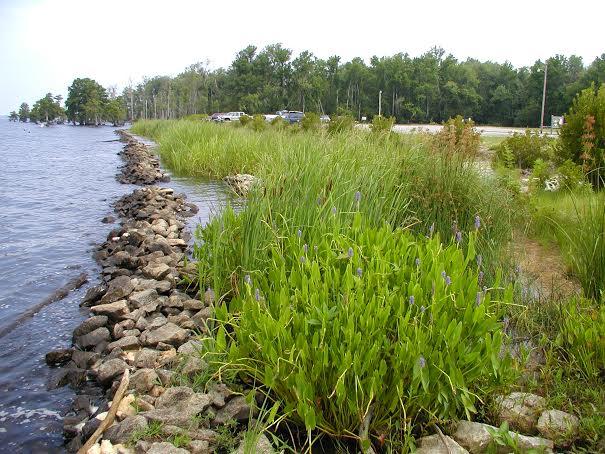
Estuarine development is one of the quickest ways to increase erosion rates. Shorelines are comprised of quaternary-age sediments and vegetation. The debris from the formation and erosion of these shorelines (trunks, branches, and roots) actually help to stabilize the shoreline from future erosion. As these items can accumulate sand that otherwise would have washed away. A natural vegetative barrier is actually the most effective way of stabilizing a shoreline.
Example of a Living Shoreline (Publicradioeast)
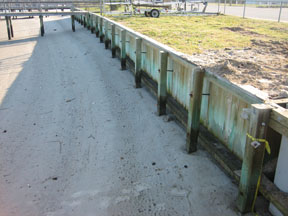
Some homeowners use hard stabilization techniques like bulkheads in order to combat natural erosion rates. Bulkheads are limited in their success and have finite lifespans. Also, homeowners have reported up to four times the maintenance costs compared to more natural stabilization techniques. 93% of evident damage from Hurricane Irene (2011) and Hurricane Arthur (2014) is attributed to bulkheads or bulkhead-like stabilization structures.
The large tourism industry has caused more impacts within the estuaries themselves. With increased demand for boating, channels are dug through shallow-water and maritime forests are removed. The ongoing dredging of these channels is also one of the most harmful processes to an estuarine system but remains virtually unregulated or addressed at any level of government.
Example of Bulkheaded shoreline with vegetation removed (NC DEQ)
Although estuarine systems receive less attention than barrier islands, their protection is equally important to the long-term health of North Carolina coasts. In 1974, North Carolina passed the North Carolina Coastal Area Management Act in order to qualify for funding from the Federal Coastal Zone Management Act of 1972. The legislation identified four areas of environmental concern, one of them being estuarine systems.
Estuarine areas of concern include areas within 75 feet of the high/normal waterline, depending on site location. Also included is the area within 575 feet of the normal water level in Outstanding Resource Waters. In these areas of concern, legislation requires that impervious surfaces make up no more than 39% of total lot areas.
However, estuaries are not well protected under development laws and are subject to hard shoreline stabilization in practice. North Carolina regulation states that new structures must be placed no closer than 120 feet to hazard areas but this ONLY applies to inlets in estuarine systems.
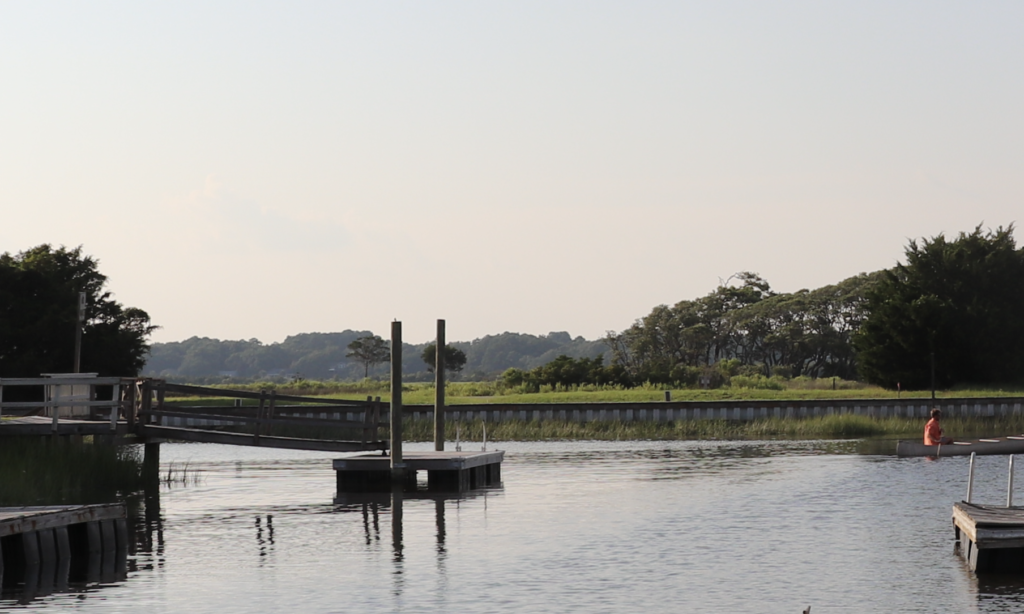
Example of Estuarine Bulkhead at Sunset Beach on recently-dredged canal.
Resources:
Pilkey, Orrin H. The North Carolina Shore and Its Barrier Islands. Duke University Press, 1998.
Smith, Carter S., et al. “Hurricane Damage along Natural and Hardened Estuarine Shorelines: Using Homeowner Experiences to Promote Nature-Based Coastal Protection.” Marine Policy, vol. 81, July 2017, pp. 350–58, doi:10.1016/j.marpol.2017.04.013.