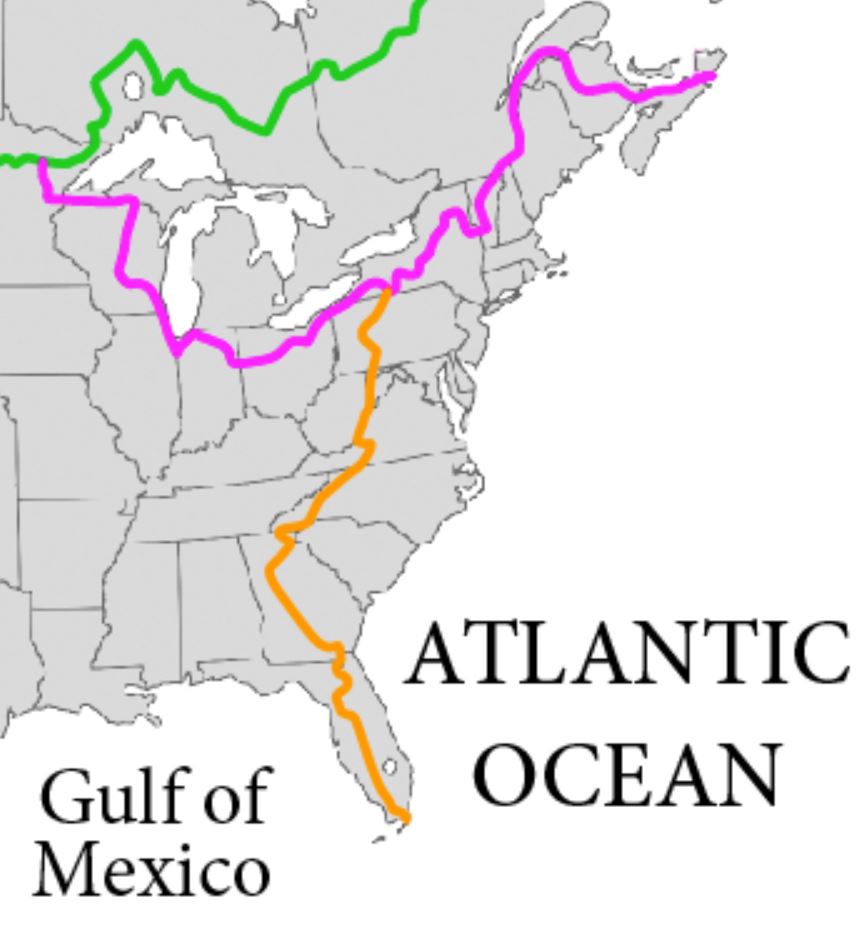
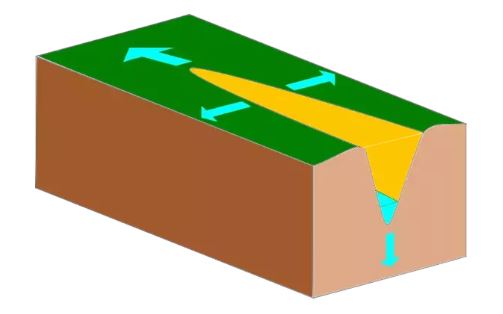
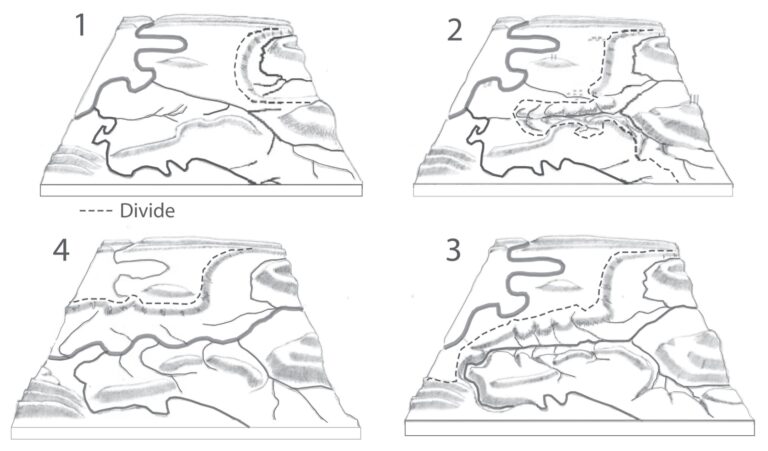
Stream capture, river capture, river piracy or stream piracy is a geomorphological phenomenon occurring when a stream or river drainage system or watershed is diverted from its own bed, and flows instead down the bed of a neighboring stream.The Blue Ridge Escarpment (BRE) is home to a large portion of the Eastern Continental Divide (ECD) where streams on the east flow into the Atlantic and streams to the west flow into the Gulf of Mexico. This divide is slowly moving as stream capture and headward erosion moves streams farther up the escarpment.
Headward erosion is the lengthening of stream channels due to erosion at the origin. As headward erosion moves the origins of streams up the BRE, stream capture is likely to happen. When a small stream has enough headward erosion to reach a larger river on the other side of the ECD, the drainage basin is diverted into the smaller steam and changes the location of the ECD.
Prince, P. S., Spotila, J. A., & Henika, W. S. (2011). Stream capture as driver of transient landscape evolution in a tectonically quiescent setting. Geology, 39(9), 823-826.
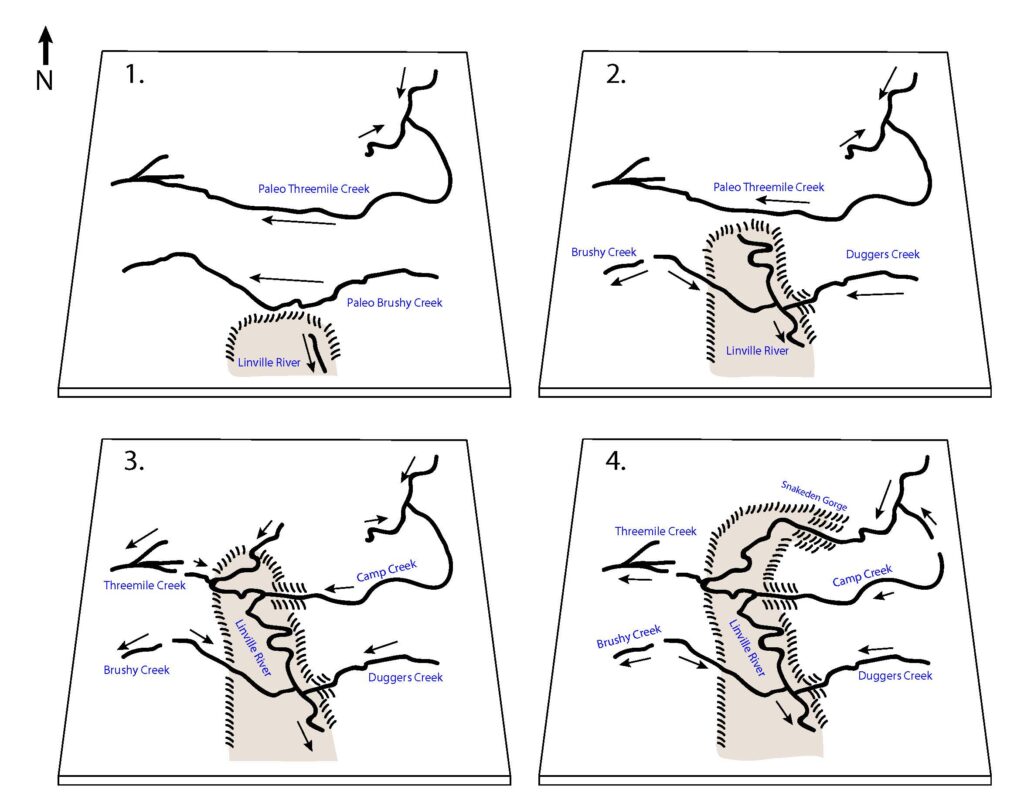
Recent research at Davidson indicates that similar processes occurred along the Linville River. Historically, the headwaters of the Linville River (those portions above the escarpment) would have followed west towards the North Toe River. We know this because quartzite stream cobbles exist Threemile Creek and Brushy Creek to the west of the modern Linville River. The only mapped source of quartzite is east of the modern Linville River.
As the lower Linville River eroded headwardly, it would have captured these small creeks. Eventually, the Linville River more than tripled its drainage area and the resulting increase in water would have driven the creation of Linville Gorge (Johnson, 2020).
Evolution of the upper Linville River valley. Stream capture and the geomorphic evolution of the Linville Gorge in the southern Appalachians, USA. Johnson, 2020.
https://doi.org/10.1016/j.geomorph.2020.107360