
The North Carolina Piedmont is not only red dirt and flat land. In addition to monadnocks such as Crowders Mountain and Pilot Mountain, the North Carolina piedmont region features a mountain range called the Uwharrie Mountains which are situated on the Carolina Slate Belt in the eastern piedmont. Although the Uwharrie Mountains once stood 20,000 feet tall, millions of years of erosion caused them to be reduced to around 1,000 feet above sea level. The Carolina Slate Belt “consists mostly of rocks originally deposited on or near the earth’s surface by volcanic eruption and sedimentation” (Rogers 10). This geologic region is known as the Carolina Slate Belt due to the slaty cleavage of many of the rocks (Rogers 10). Fossil evidence reveals that this terrane can be traced back to the Cambrian age, making it around 500 million years old. The fossil evidence also shows indicates that the terrane was once part of the western margin of South America and docked(ie. collided) with eastern North America (Rogers 11). After docking with the continent of North America, much of the terrane’s rock underwent low-grade metamorphosis, creating the quartz and plagioclase that is characteristic of the region (Rogers 12). The formation of the Carolina terrane bears resemblance to “Pan-African” neoproterozoic terranes as many of these terranes were formed by tectonic movement during the closure of ocean basins and the creation of the supercontinent “Gondwa” (Wortman 333). It is important to remember that this the formation of the Carolina terrane did not happen in an instant in fact researchers believe that the Carolina terrane experienced at least 100 million years of magmatic activity during which features such as the Uwharrie mountains were formed.

The Carolina Slate Belt is divided into two “rock suites”: the Uwharrie suite and the Virgilina suite. The Uwharrie suite makes up the entire Uwharrie mountain range while the Virgilina suite comprises the remainder of the Carolina Slate Belt. The rocks from the Uwharrie suite “appear to have been deposited in a rift in a microcontinent that may already have separated from South America before the internal rifting occurred” (Rogers 11). On the other hand, the rocks from the Virgilina suite are believed to be the result of a chain of volcanic islands on “oceanic lithosphere.” The rocks from the Virgilina suite are older than those of the Uwharrie suite and the mechanism by which the Uwharrie and Virgilina suites joined is still uncertain (Rogers 11). The age of the rocks found in the Uwharrie suite is uncertain but researchers believe that they are younger than 600 million years. Fossil evidence indicates that “most deposition in the North Carolina part of the Carolina Slate Belt occurred before the end of the Proterozoic” (Rogers 14).
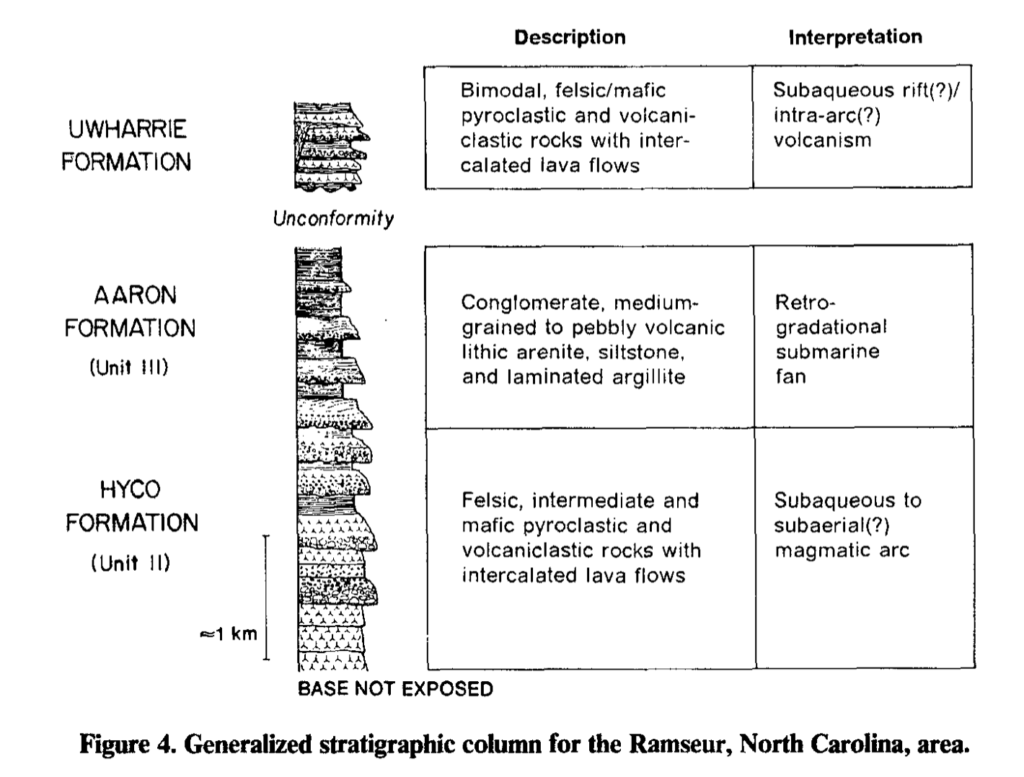
The stratigraphy of the Carolina Slate Belt is divided into three different formations: the Hyco, Aaron, and Uwharrie. The Hyco formation features a variety of volcanic rock that resulted from lava flows. The Aaron formation consists of different types of pebbled and conglomerate rock from erosion of the Hyco formation. The Uwharrie formation has a similar composition to the Hyco and is made up of “felsic volcanic rocks” (Harris and Glover 202-207). Between the Aaron and Uwharrie formations there is an unconformity, meaning there is a break in the geological record within the stratigraphic column. Researchers estimate that the Uwharrie formation is at least 50 million years younger than the Aaron and Hyco formations (Harris and Glover 200). The geological correlation between the Uwharrie formation and the other two formations is still uncertain according to researchers (Harris and Glover 214).
Works Cited
Harris, Charles W., and L. Y. N. N. GLOVER III. “The regional extent of the ca. 600 Ma Virgilina deformation:Implications for stratigraphic correlation in the Carolina terrane.” Geological Society of America Bulletin 100.2 (1988): 200-217.
Rogers, John JW. “The Carolina Slate Belt.” Stone Quarries and Sourcing in the Carolina Slate Belt,(Eds V. Steponaitis, J. Irwin, T. McReynolds, and C. Moore), University of North Carolina Research Laboratories of Archaeology, Research Report 25 (2006): 10-15.
Wortman, Greg L., Scott D. Samson, and James P. Hibbard. “Precise U-Pb zircon constraints on the earliest magmatic history of the Carolina terrane.” The Journal of Geology 108.3 (2000): 321-338.
